
Managing Pain and Fever in Young Children: Over the Counter Medicines
Medication Dosages
The two most common over-the-counter medications that GROW docs recommend are Acetaminophen (Tylenol) and Ibuprofen (Advil or Motrin). While both are effective, they work differently and have specific age requirements.
Acetaminophen (Tylenol)
- Safe Age: Can be used from birth (consult a doctor for infants under 3 months).
- Best For: General pain, headaches, and fevers.
- Frequency: Can be given every 4 to 6 hours, not to exceed 5 doses in 24 hours.
Ibuprofen (Advil/Motrin)
- Safe Age: Only for children 6 months and older.
- Best For: Inflammation, earaches, menstrual cramps and higher fevers. It generally lasts longer than acetaminophen.
- Frequency: Can be given every 6 to 8 hours, not to exceed 4 doses in 24 hours.
Safety Tips
If alternating medications for severe fevers, keep a written record of what was given and when so you do not forget
The 6-Month Rule: While acetaminophen can often be used earlier with a doctor’s guidance, ibuprofen (Motrin/Advil) should never be given to infants under 6 months of age unless explicitly directed by your pediatrician.
Avoid Aspirin: Never give aspirin to a child or teenager unless specifically directed by a doctor, due to the risk of Reye’s Syndrome, a rare but serious condition.
Dose by Weight, Not Age: Children’s bodies process medication based on their mass. Always use your child’s most recent weight for the most accurate dose.
Rounding: If your child’s weight falls between two categories, it is generally safer to use the dose for the lower weight unless your doctor advises otherwise.
Use the Provided Syringe or Measuring Cup: Never use kitchen spoons. Always use the oral syringe, plunger, cup or dropper that came with the specific bottle of medicine.
Check the Concentration: “Infant” and “Children’s” liquids used to have different concentrations, leading to dosing errors. While most brands have standardized this, always double-check the label for the “mg per mL” amount. Before dosing, confirm if your bottle says “Infant Concentrated Drops” or “Children’s Liquid/Suspension.”
Tips for Administration
If your child resists taking medicine, try placing the plunger toward the inside of the cheek rather than the back of the throat to prevent gagging. For infants, following the medicine with a small amount of milk or formula can help mask the taste and prevent stomach upset, which is occasionally seen with ibuprofen.
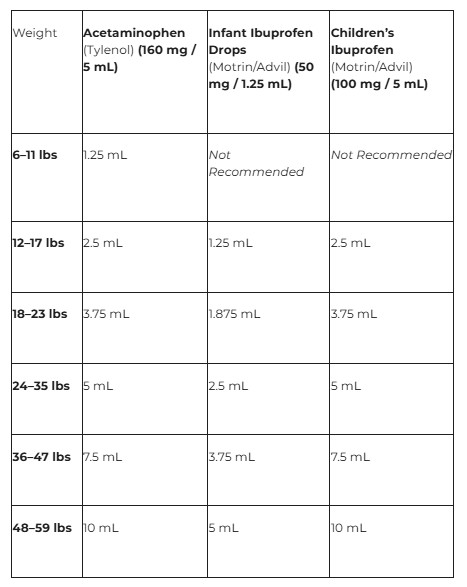
Pediatric OTC Pain Meds Dosing Chart
Please use the table below to determine the correct volume based on your child’s weight.
Important! Remember that infant ibuprofen is much more concentrated (50 mg per 1.25 mL) than the standard children’s ibuprofen liquid (100 mg per 5 mL). Because the infant version is more potent, the volume (mL) required is smaller. The reason “infant ibuprofen” exists as a concentrated drop is to allow parents to give a very small amount of liquid to a baby who may have trouble swallowing larger volumes. However, this can create a high risk for dosing errors. Check the label, every time.
When to Call GROW or go to the ER
Fever is the body’s natural way of fighting infection and isn’t always “bad.” However, contact us immediately or seek appropriate medical attention if:
- The fever lasts more than 3 days.
- An infant under 3 months has a rectal temperature of 100.4°F (38°C) or higher.
- Your child is unusually lethargic, has a stiff neck, or shows signs of dehydration (fewer wet diapers).
- The pain does not respond to the medications listed above.